Species monitoring · Newfoundland and Labrador
Pink salmon in Newfoundland and Labrador
Documenting occurrences and eDNA detections across a changing North Atlantic.
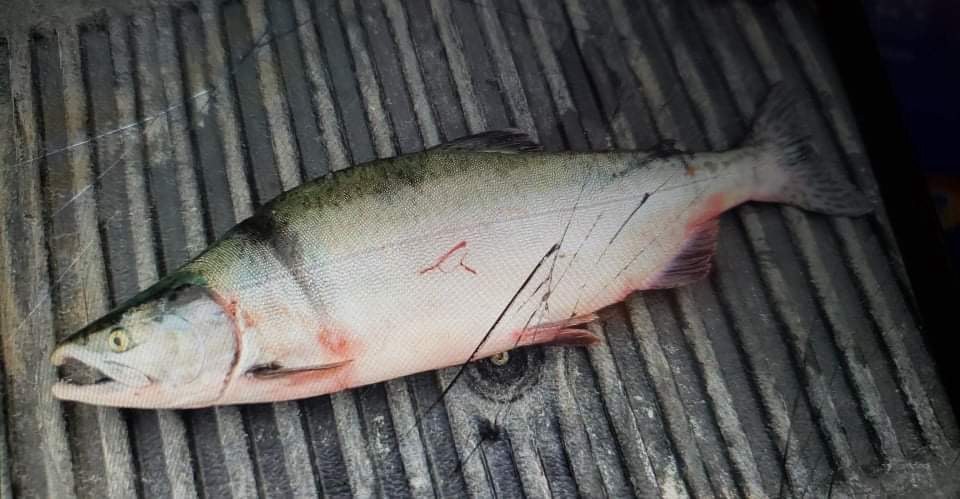
Pink salmon (Oncorhynchus gorbuscha), native to the North Pacific, are increasingly reported in North Atlantic waters. Documenting their occurrence in Newfoundland and Labrador helps establish a baseline for assessing dispersal, possible establishment, and potential interactions with native salmonids, including Atlantic salmon. This page brings together reported fish observations and environmental DNA (eDNA) detections from 2014–2026. These records document occurrence or detection; they do not, by themselves, demonstrate successful reproduction or an established population.
Oncorhynchus gorbuscha — documented occurrences and environmental DNA detections, 2014–2026.
Environmental DNA monitoring in Labrador
Environmental DNA (eDNA) monitoring provides a complementary approach to conventional fish surveys by detecting genetic material released into aquatic environments. Surveys across Newfoundland and Labrador identified pink salmon (Oncorhynchus gorbuscha) at multiple locations, including high-certainty eDNA detections from 2019 and 2021. The published survey summarized detections across three genetic markers.
Ongoing fieldwork also incorporates passive eDNA filtration systems, as shown in the fieldwork video below. These devices collect environmental DNA from flowing water without continuous active pumping, offering a practical approach for monitoring remote freshwater environments. The historical eDNA detections shown on the map should not be assumed to have been collected using this passive system.
The interactive map combines eDNA detections with specimen and observation records to document pink salmon occurrence. These records provide a baseline for tracking distribution over time, but detections alone do not establish successful reproduction or self-sustaining populations.
Detection records
Mapped occurrences
The map summarizes environmental DNA (eDNA) detections and reported specimen or observation records. Pink circles represent eDNA detections; blue triangles represent specimen and observation records. Symbols may overlap where records share a location. eDNA detections indicate the presence of target DNA, not necessarily a captured fish.
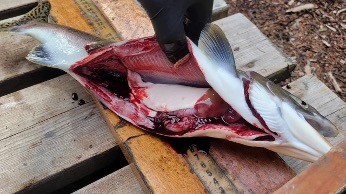
Photographic documentation — English River, 2023 and 2026
Mature male pink salmon documented at English River, Labrador, in 2023, alongside roe from a mature female documented on 24 August 2026.

Field identification
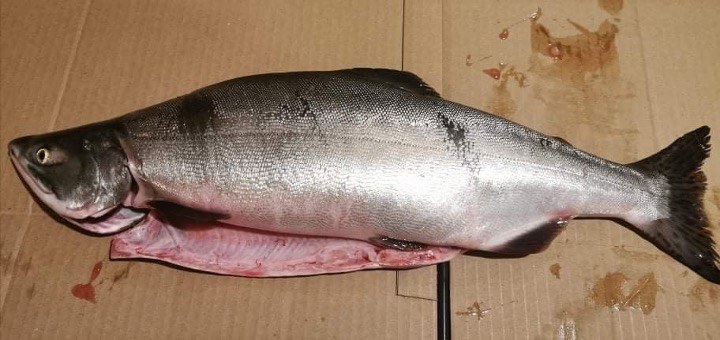
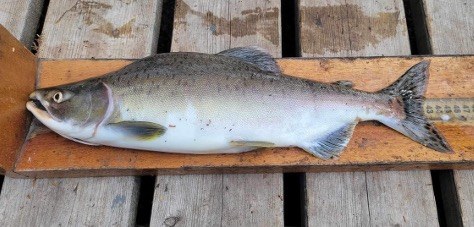
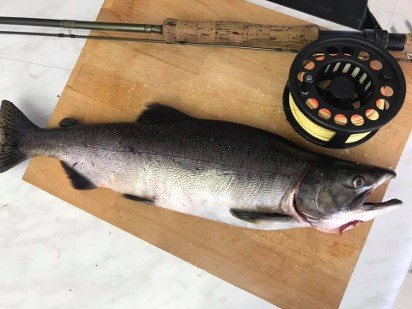
Pink salmon (Oncorhynchus gorbuscha) can be distinguished from Atlantic salmon and Arctic charr by prominent dark oval spots on the tail, fine scales, and a pale mouth with dark gums. Breeding males develop a pronounced dorsal hump and hooked jaws. Photographs showing the full fish, tail, and mouth are particularly useful for documenting suspected occurrences.
Documented observations: field photographs
Selected photographs illustrating the appearance of pink salmon, including the dorsal hump characteristic of breeding males. Locations and dates for these four images have not been verified.
Reporting and sample documentation
For new observations, record the date, location (ideally GPS coordinates), observer, capture or observation method, and identifying features. Take clear photographs of the whole fish, tail and mouth; where feasible and permitted, record fork length and weight. Preserve biological samples only under appropriate permits and approved protocols, with a unique specimen identifier linking the sample to the observation.
Photographs and mapped observations may document the same event and should not be counted as separate occurrences. Records are presented using the classifications in the underlying datasets.