Following secondary contact, two distinct lineages of introduced European green crabs hybridized, forming a latitudinal genetic cline along the Eastern North American coast. Using a panel of 96 SNPs, Lehnert et al. show that this cline has continued to shift southward at a slower rate than previously predicted and suggest that neutral and selective processes contribute to cline dynamics, and ultimately, highlight how selection, hybridization, and dispersal can collectively influence invasion success.
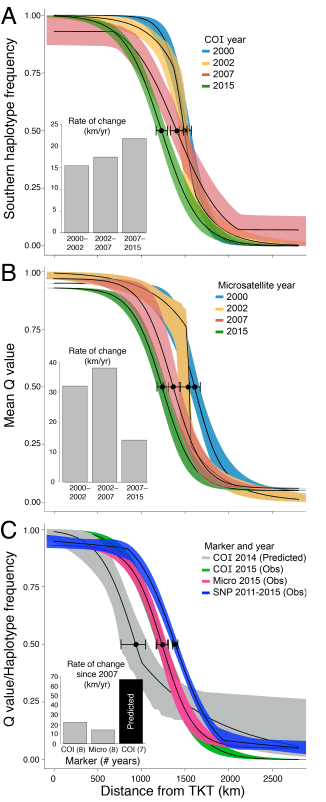
Figure 4 from Lehnert et al. 2018
 Bradbury Population Genomics Lab